Showing posts with label asparagus. Show all posts

Thursday, July 24, 2014

Top Three Signs

...you didn't pick enough asparagus.

Probably the thing that most often confuses visitors in my garden is the asparagus. It is an unusual crop, in that we eat the shoot, rather than the fruit, or leaves, or tuber/bulb.  Many people have never even seen an asparagus plant with leaves on it. One recent visitor, after asking what kind of plant it was and being answered, looked at the outrageous tangle of ferny branches skeptically and asked, "Where do they come out?"

Asparagus is a perennial that lives for about 30 years.  Starting in the third or fourth year after planting, the gardener waits for the first spears to pop out of the ground in spring, and cuts them off as soon as they are about six inches tall.  After several weeks of cutting, you stop and let the plants grow, forming a bushy, fern-like plant. (It's really kind of pretty in gardens other than mine.). The plant rests the remainder of the season, storing energy for next spring.

So, what about those three signs?
1. Your asparagus is huge.  Way bigger than the lovely patches you see in adjacent gardens.  Taller than your husband and so tangled and widely branched that you have to remove your hat and put a scarf over your hair and teach your child to dial 9-1-1 before you can weed under it.
2. Halfway through cutting and removing the crazy mass of tangled branches, you discover a bird's nest.  Sorry little birdy.
3.  After dragging the branches, backwards and cursing, down the path and out of the garden, you go back to clear out the weeds underneath it and a giant toad hops right across your foot, running for his life as you destroy what used to be his nice shady home.  Sorry little toad.

If these three signs occur in your garden, you can be 100% certain - you should have picked more asparagus last spring.

I'm hoping my little exercise this week will take some vigor out of the plants and make them a little more reasonable.  I'm also hoping that little birdie will find her nest.

Thursday, November 1, 2012

Sandy

Mud puddles are irresistible for A.  Five minutes after our arrival we had to leave quickly.


The 6-8 inches of clearance under this board are full of water

 The day after the hurricane I packed up the boys and we went out to survey the damage at the garden.  Mostly it was just very wet out there.  The puddle at the top covered the front half of my neighbor's huge (3x bigger than mine) plot.  Luckily he doesn't really put in a fall garden, so it didn't look like he lost anything.  I have been working recently to fill in the ditch at the front of my garden (the "clumpwater" as R used to call it) with mulch, so the only flooded spot in my garden was where I left a small space under the former bridge for toads to hide out.  It seems so ridiculous compared to the pictures coming out of New York and the Jersey shore.

Tipped-over lettuce stalks
I did have a few plants knocked over, mostly the lettuces that had gone to seed, plus a few broccoli plants and some fading asparagus.  Hopefully the asparagus crowns will figure out that it's too late in the year and not bother to replace those fading fronds, which would have had to be cut anyway in a month or so.


Wind-blown broccoli plants near the edge of my plot

Broken asparagus stalks


All in all, Sandy really spared us.


Saturday, June 23, 2012

How's the Garden?

The community garden plot
June is a precarious time in the garden.  There's a lot of empty space around plants that aren't yet fully established - prime weed-growing real estate.  There's also (in my area) not a whole lot of rain falling, so many of the newly planted summer crops need water.  Add that to the relatively little harvesting and planting to be done and the human tendency to steer clear of heat and burning-bright sunshine and you have a real recipe for disaster.  This is when we lose a lot of the new gardeners at the community garden.

Luckily, I am behind schedule this year, so I have plenty of reasons to crawl out of bed and go take care of things.  Here's a rundown of the crops currently in the community garden plot:
  • Potatoes - seem to have some sort of fungus or disease causing the outside edges of the leaves to blacken, but I think it won't seriously harm the yield.  At any rate there will certainly be plenty of potatoes this year.
  • Tomatoes - Both rows are setting fruit, but the ones in the back row are larger.  Both rows also seem to have the fungal problem I was worried about in the spring, which I think is gray mold.  The back row really needs to be tied and pruned - I'll have to get to that this week.
  • Garlic - some if not all of the garlic is probably ready to be picked.  The plants are browning and seem to be shrinking before my eyes as the energy from the plant slowly goes into storage in the bulb.
  • Carrots - there are three rounds in the ground right now, with the oldest ones ready to pick and the smallest ones barely out of the ground.  I really should have put more compost into the carrot bed before I planted it - the carrots I'm harvesting are pretty stubby and crooked and split from the hard clay soil.
  • The back peas aren't really producing much anymore, thanks to the heat, I just haven't gotten around to pulling them out yet.  I'll plant some beans there soon.
  • The onions are so exciting right now.  It's my first year growing bulbing onions, so I'm trying not to get too excited, but it's really hard when they are clearly making onions!  I don't know when they'll be done, but I'm thinking at least another month.
  • The asparagus seem to be loving life.  They could use some light weeding, and maybe some fertilizer soon, but mostly they seem to take care of themselves.
  • The back pepper plants are starting to produce lots of peppers (bell and chili), while the front ones are still getting over being trasplanted.  Also I think the front ones are a little chlorotic.  I think the wood chips I added were not sufficiently rotted and now I'm worried there's not enough nitrogen in those two beds.  I watered them with some fish emulsion, and threw some more coffee grounds over the soil, so hopefully they will start to look better soon.
  • The celeriac is bushy and I think I can see the tops of the thick roots widening below the soil.  I'm continuing to weed the bed, but other than that I leave them alone.
  • There are little cucumber starts tucked between some of my pepper plants that look like they're starting to take off.  It's good because I'm almost out of pickles!
  • The eggplants are all growing, although they're still getting torn up pretty badly by flea beetles.  The ones I started at home, which were horribly ragged when I planted them, are starting to close the gap with the nursery-bought transplant.
  • The bed that used to have the broccoli in it is full of new little things whose outcome is far from certain.  There are two watermelon starts, a butternut squash start, a spare bell pepper plant and marigold that look pretty happy, and lots of little carrot and basil sprouts.
  • The front bed is newly planted with summer squash: zucchini, yellow squash, and tromboncino (seeds).  There's also an extra 6-8 feet of space in there that I think I may use for beans.   I definitely don't want to plant extra summer squash!
  • I haven't seen much action where I planted the parsley seeds.  I wonder if those seeds are no good any more.  I'll give them a little more time and then try some other seeds.
Whew!   The little bit of extra planning I've done this year has made a tremendous difference in how efficiently I'm using the garden space.  Can you tell I'm really proud of the garden?  Cause I am.

Saturday, June 16, 2012

Female Asparagus

Female asparagus spear

Male asparagus spear

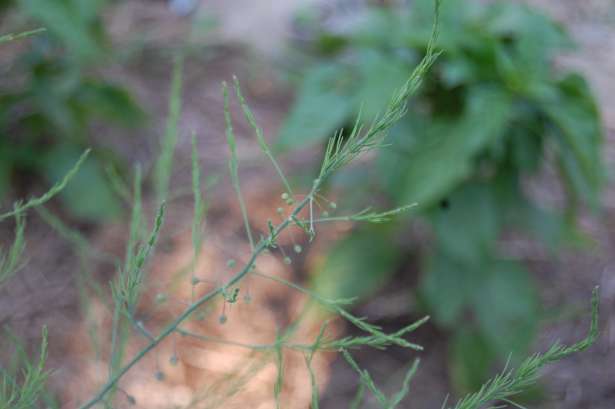
Asparagus plants have been a real surprise to me, and to every non-gardener who's visited my garden this year.  The finger-like spears you find at the grocery store are very young shoots, picked just a couple days after they emerge from the ground.  We have all been sort of bemused to see those little fingers (which are extra petite on my young plants) open up and spread out into these tall, spindly, airy puffs of green so insubstantial that the camera looks right through them.  (Sorry about the pictures.  Clearly I am helpless without autofocus.)

Recently I noticed something funny about one of the asparagus plants at my community garden plot.  It has all these little crumb-sized pods sticking out from the stems.  My first thought was that it was some sort of disease or infestation, but after squinting at it for a minute a memory stirred in the back of my brain - something about growing asparagus from seed.  You see, asparagus plants are gendered, so when you start your plants from seed, half the plants that grow are naturally female, while the other half are male.  And female asparagus produce...berries!  Cool, right?

Well, not really.  Unlike the barnyard, the asparagus patch is the ruled by the males.  Male asparagus have higher yields, because more of their energy goes into producing spears, and the berries are actually a nuisance because they tend to over-populate the bed.  Steve Solomon's advice?  Plant at twice the desired spacing and kill the women!  All's fair in love and food.

Sunday, April 22, 2012

Good Bugs That Eat Bad Bugs


A couple weeks ago I noticed that a few of my romaine lettuces were looking a little yellow. On closer inspection I could see that they were under attack by aphids. The aphids have been worse than usual this year, I think because we haven't had much rain to wash them off of the plants. When I got home I mixed up a bottle of my recently purchased neem oil to spray on them at my next visit. Neem oil is an organic insecticide/fungicide/bad-stuff-icide that has been highly recommended by other gardeners I trust, but this was my first time using it due to the fact that I'm cheap and it's not.

Then, as I was bent over trying to squirt the darned stuff under the low-lying romaine leaves, I saw an even better reason to stop spraying: ladybug larvae. At the time I couldn't even remember their name, but I knew them as friends. Good bugs, as Mercer Mayer would tell us - because they eat aphids. I found two on the lettuce and one on my asparagus (also under aphid attack), enjoying a nice little picnic.


Supposedly neem is not toxic to ladybug beetles themselves, but I'm not so sure about the larvae. Here's hoping I didn't kill them, because I sure doubt I managed to spray all the aphids. (Note: The image above was blatantly stolen from Chikblog.)